


Measuring the Real Impact of Training Investments
- Global Safety Training
- Feb 23
- 2 min read
In today’s competitive business environment, organizations invest heavily in employee training — especially in critical areas such as occupational health and safety. However, a fundamental question remains:
How do we measure whether training truly delivers value?
The answer lies in the Phillips Evaluation Model, developed by Dr. Jack J. Phillips in the 1990s. This model builds upon the well-known Kirkpatrick framework and introduces a powerful fifth level — Return on Investment (ROI) — transforming training evaluation from a learning metric into a business performance tool.
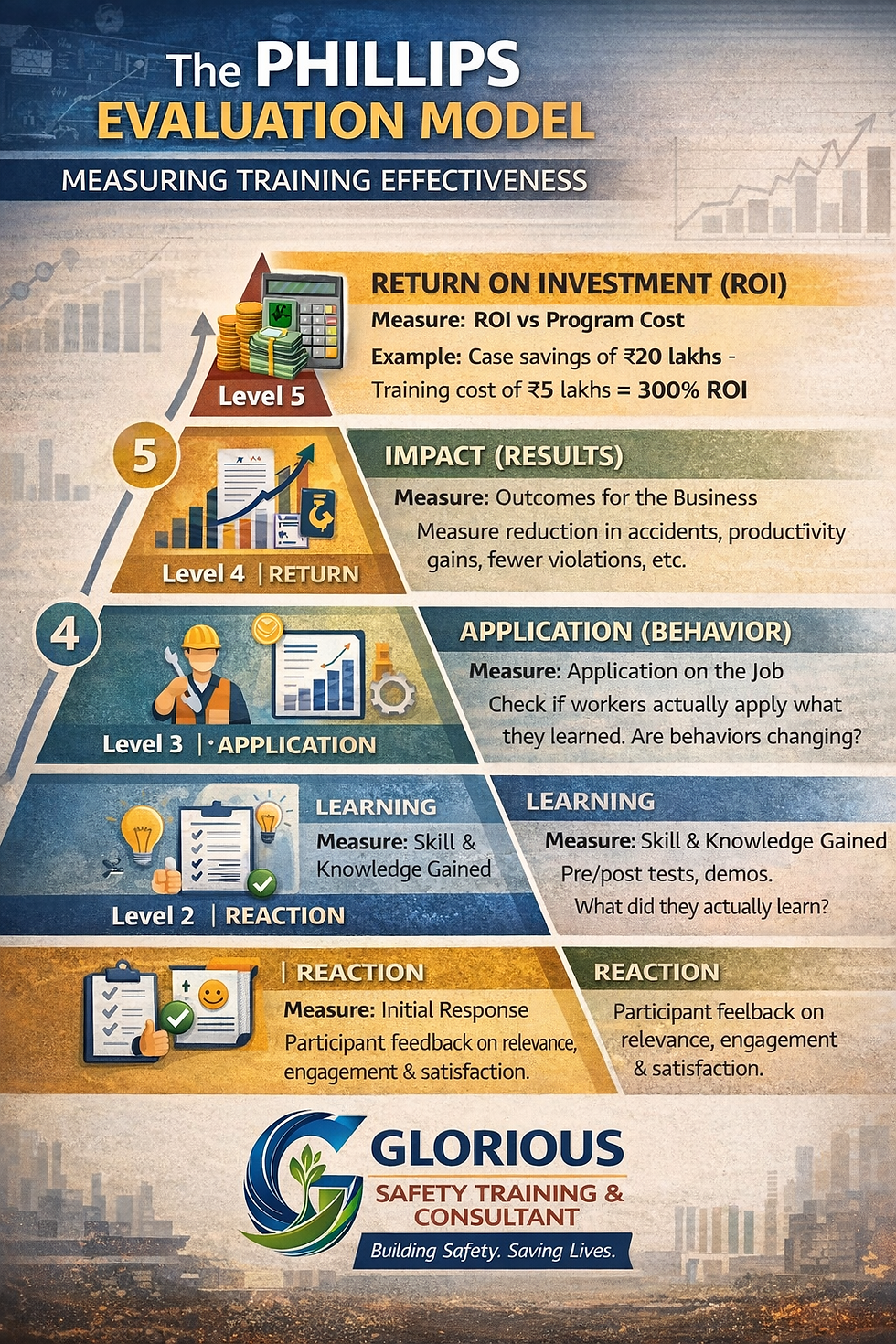
Understanding the Phillips Evaluation Model
The Phillips Model expands the traditional four levels of evaluation by adding a financial accountability dimension.
Level 1: Reaction
Measures participants’ immediate response to training.• Did they find it useful?• Was it relevant and engaging?
Common tools: Feedback forms, satisfaction surveys.
Level 2: Learning
Measures knowledge or skill acquisition.• What did participants actually learn?• Did competence improve?
Common tools: Pre- and post-tests, skill demonstrations.
Level 3: Application (Behavior)
Measures whether participants apply what they learned on the job.• Are safety procedures being followed?• Has behavior changed at the workplace?
Common tools: Observation, supervisor reports, audits.
Level 4: Impact (Results)
Measures the business outcomes resulting from behavior change.• Reduction in accidents• Lower absenteeism• Improved productivity• Reduced compliance violations
At this stage, training begins to show measurable organizational value.
Level 5: Return on Investment (ROI)
This is where the Phillips Model stands apart.
ROI converts training results into monetary value and compares them to training costs.
ROI(%)=NetProgramBenefitsProgramCosts×100ROI (\%) = \frac{Net Program Benefits}{Program Costs} \times 100ROI(%)=ProgramCostsNetProgramBenefits×100
If safety training reduces accident-related losses by ₹20 lakhs and the program cost ₹5 lakhs:
Net Benefit = ₹15 lakhs ROI = 300%
This level allows top management to view training as a strategic investment rather than an expense.
Why the Phillips Model Matters in Safety Training
In occupational health and safety, measurable impact is critical. Research shows that organizations with structured safety training programs experience:
• Up to 20–40% reduction in workplace incidents• Lower insurance premiums• Fewer legal liabilities• Improved employee morale• Enhanced brand reputation
However, without systematic evaluation, these benefits remain invisible to leadership.
The Phillips Model bridges that gap by linking safety training to financial outcomes.
Application in Construction & Industrial Sectors
In high-risk industries such as construction, manufacturing, and pharmaceuticals:
• Reduced Lost Time Injury Frequency Rate (LTIFR)• Fewer near-miss incidents• Lower compensation claims• Reduced downtime
When converted into cost savings, these improvements demonstrate measurable ROI, justifying continued investment in safety programs.
Key Advantages of the Phillips Model
✔ Aligns training with business strategy✔ Provides measurable financial accountability✔ Supports data-driven decision making✔ Strengthens executive buy-in✔ Enhances credibility of HR and safety departments
Challenges to Consider
While powerful, the model requires:
• Accurate data collection• Proper isolation of training effects• Financial expertise for benefit calculation• Strong internal reporting systems
Organizations must be committed to disciplined evaluation practices for reliable ROI measurement.
Conclusion: From Training Activity to Business Impact
The Phillips Evaluation Model transforms training measurement from simple satisfaction surveys into a comprehensive financial analysis tool.
For safety-focused organizations like Glorious Safety Training and Consultant Pvt Ltd, applying the Phillips Model ensures that:
Training does not just inform — it performs.
By measuring ROI, organizations can demonstrate that safety training protects lives and strengthens financial performance.


Comments